

Molecular Glues Clinical Trial Landscape: 80+ Emerging Competitors, Pipeline Dynamics, and Future Opportunities | DelveInsight
The molecular glues competitive landscape report delivers important insights into approved as well as ongoing research of 90+ pipeline molecular glues, clinical strategies, upcoming therapeutics, and commercial analysis.
New York, USA, July 23, 2026 (GLOBE NEWSWIRE) -- Molecular Glues Clinical Trial Landscape: 80+ Emerging Competitors, Pipeline Dynamics, and Future Opportunities | DelveInsight
The molecular glues competitive landscape report delivers important insights into approved as well as ongoing research of 90+ pipeline molecular glues, clinical strategies, upcoming therapeutics, and commercial analysis.
DelveInsight’s Molecular Glues Competitive Landscape 2026 report provides comprehensive global coverage of approved and pipeline molecular glues across various stages of clinical development. The report offers an in-depth analysis of key trends, emerging therapies, and competitive landscape dynamics, highlighting the strategies of major pharmaceutical companies to advance the pipeline and capitalize on future growth opportunities. In addition, it includes critical insights into clinical trial benchmarking, partnering and licensing activities, and regulatory pathways involving the FDA and EMA, enabling stakeholders to make informed decisions and optimize development strategies within the molecular glues domain.
Key Takeaways from the Molecular Glues Pipeline Report
- DelveInsight’s molecular glues competitive report presents a robust market with over 80 active players developing more than 90 pipeline molecular glues.
- Key molecular glues companies, such as Revolution Medicines, Inc., Gluetacs Therapeutics (Shanghai) Co., Ltd., Captor Therapeutics, GluBio Therapeutics, Nurix Therapeutics, Inc., MindRank Ltd., Monte Rosa Therapeutics, SEED Therapeutics, Inc., Neomorph, Amphista Therapeutics, Degron Therapeutics Co., Ambagon Therapeutics, Incyte Corporation, BioTheryx, Inc. Amgen Inc. and others, are evaluating new molecular glues to improve the treatment landscape.
- Promising pipeline molecular glues, such as Daraxonrasib, GT919, CT-01, GLB-001, Zelebrudomide, MRANK-103, Research programme: NEK7, NEO-811, TEAD Targeted Glue™ program, SMARCA2 program, DEG6498, GT969, GT929, Research Programme : BioTheryx, Inc AMG-193 and others, are under different phases of molecular glues clinical trials.
- Approximately 7+ molecular glues are in the late stage of development, whereas 15+ drugs are in the mid and early stages of development.
- Notable MoA in molecular glues clinical trials include RAS(ON) inhibitor, GSPT1 degraders, NEK7 degraders, SALL4 degraders, CK1α degraders, Agammaglobulinaemia tyrosine kinase degraders, IKZF1 protein degraders, IKZF3 protein degraders, c-Myc degraders, and others.
Request a sample and discover how do molecular glues enhance protein-protein interactions @ http://delveinsight.com/report-store/molecular-glues-competitive-landscape
What are Molecular Glues?
Molecular glues are a class of small molecules that induce or stabilize interactions between two proteins that would otherwise have little or no affinity for each other, thereby modulating cellular functions in a highly selective manner. Unlike traditional inhibitors that block the activity of a target protein, molecular glues promote the formation of a protein–protein complex, often leading to the degradation of disease-causing proteins through the ubiquitin-proteasome system. Many molecular glues function by recruiting a target protein to an E3 ubiquitin ligase, resulting in ubiquitination and subsequent proteasomal degradation of the target. This mechanism has emerged as a promising therapeutic strategy for addressing previously "undruggable" proteins, particularly in oncology, immunology, and neurodegenerative diseases. Notable examples include immunomodulatory drugs (IMiDs) such as thalidomide and its analogs, which act as molecular glues by redirecting the E3 ligase cereblon to degrade specific transcription factors. The growing interest in molecular glues stems from their ability to expand the druggable proteome and offer novel treatment approaches for diseases with limited therapeutic options.
To know more about the difference between PROTACs and molecular glues, visit @ Molecular Glues vs PROTACs Differences
Approved Molecular Glues Drug Profile Analysis
POMALYST: Bristol Myers Squibb
POMALYST® (pomalidomide) is a prescription medication indicated for adults with multiple myeloma in combination with dexamethasone. It is intended for patients who have previously undergone at least two prior therapies, including a proteasome inhibitor and lenalidomide, and whose disease has progressed during treatment or within 60 days after completing their most recent therapy. The safety and efficacy of POMALYST in pediatric patients have not been established.
REVLIMID: Bristol Myers Squibb
REVLIMID® (lenalidomide) is a prescription therapy used in adults with multiple myeloma, either in combination with dexamethasone or as maintenance treatment following autologous hematopoietic stem cell transplantation. It is not approved for the treatment of chronic lymphocytic leukemia (CLL) outside of controlled clinical studies, and its safety and effectiveness in children remain unknown. In addition to multiple myeloma, lenalidomide has received approvals across several hematologic malignancies, including follicular lymphoma, mantle cell lymphoma, marginal zone B-cell lymphoma, and myelodysplastic syndromes.
Find out more about are molecular glues easier to discover than PROTACs initial discovery feasibility @ Molecular Glues Analysis
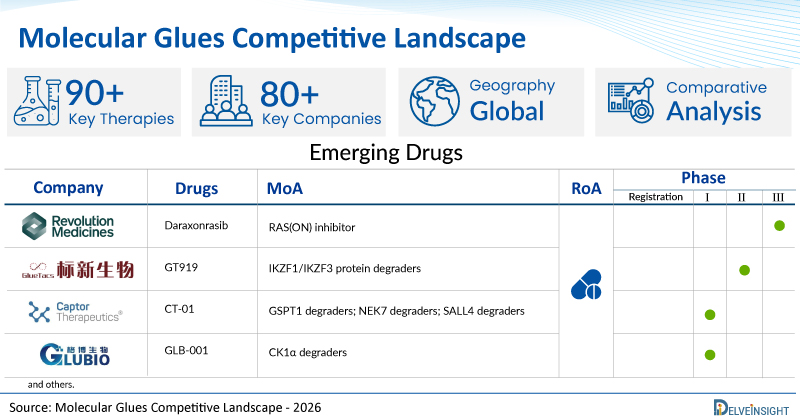
A snapshot of the Pipeline Molecular Glues mentioned in the report:
| Drugs | Company | Phase | MoA | RoA |
| Daraxonrasib | Revolution Medicines, Inc. | III | RAS(ON) inhibitor | Oral |
| GT919 | Gluetacs Therapeutics (Shanghai) Co., Ltd. | II | IKZF1/IKZF3 protein degraders | Oral |
| CT-01 | Captor Therapeutics | I | GSPT1 degraders; NEK7 degraders; SALL4 degraders | Oral |
| GLB-001 | GluBio Therapeutics | I | CK1α degraders | Oral |
| Zelebrudomide | Nurix Therapeutics, Inc. | I | Dual degrader targeting Bruton’s tyrosine kinase (BTK) and the cereblon neosubstrates IKZF1 and IKZF3 | Oral |
| MRANK-103 | MindRank Ltd. | Preclinical | c-Myc degraders | Oral |
| Research programme: NEK7 | Monte Rosa Therapeutics | Preclinical | NEK7 degrader | NA |
Learn more about the emerging molecular glues @ Molecular Glues in Clinical Trials
As per Stuti Mahajan, consulting manager at DelveInsight, molecular glues represent a highly differentiated approach to targeted protein degradation, enabling the selective elimination of disease-causing proteins that are often considered “undruggable” by conventional modalities. As clinical validation grows, molecular glues are expected to attract significant investment and partnering activity, with the potential to expand treatment options across oncology, immunology, and neurodegenerative diseases while offering advantages in selectivity and drug-like properties.
Recent Developments in the Molecular Glues Treatment Space
- In April 2026, Monte Rosa Therapeutics presented preclinical data highlighting the potential of its highly selective, first-in-class cyclin E1 (CCNE1)-directed MGD, MRT-55811, to treat CCNE1-amplified solid tumors at the American Association for Cancer Research (AACR) Annual Meeting 2026.
- In April 2026, Nested Therapeutics reported initial clinical results from its ongoing Phase I study evaluating NST-628, a brain-penetrant non-degrading pan-RAF/MEK molecular glue, in patients with advanced solid tumors.
- In April 2026, Amphista Therapeutics presented new preclinical data from its molecular glue degrader programs targeting SMARCA2 and TEAD at the AACR 2026 Annual Meeting. The company reported potent and selective target degradation through novel E3 ligase recruitment mechanisms, including DCAF16 and FBXO22, and also published the first detailed data from its TEAD program.
- In April 2026, Neomorph announced the presentation of new data on its molecular glue degrader pipeline at the American Association for Cancer Research (AACR) Annual Meeting 2026, highlighting progress with NEO-811, a first-in-class ARNT (HIF-1β)-targeted molecular glue degrader being developed for clear cell renal cell carcinoma (ccRCC).
- In March 2026, SEED Therapeutics announced that it will present new preclinical data at the AACR Annual Meeting 2026 highlighting the anticancer activity of its RBM39-targeting molecular glue degrader program. The presentation focuses on the ability of the RBM39 degrader to demonstrate potent activity against neuroblastoma, while also identifying MYC and CDKN2A/B as potential response biomarkers. The data further support SEED’s molecular glue degrader platform and its strategy of targeting previously undruggable proteins through selective protein degradation approaches for oncology applications.
- In December 2025, Degron Therapeutics announced that its first-in-class HuR (Human antigen R)–targeting molecular glue degrader, DEG6498, has been successfully administered to the first clinical trial subject in a first-in-human Phase 1 study DEG6498-ONC-2401 in November 2025 in China.
- In December 2025, Gluetacs Therapeutics announced the successful enrollment of the first patient in its Phase II clinical trial of GT919. GT919 is a highly selective, self-developed oral molecular glue degrader (MGD) being evaluated for the treatment of relapsed or refractory POEMS syndrome.
- In August 2025, Seed Therapeutics, Inc. announced that the US Food and Drug Administration (FDA) has cleared its Investigational New Drug (IND) application for ST-01156. The clearance enabled initiation of a first-in-human Phase 1 clinical trial in patients with advanced solid tumor and hematological malignances, prioritizing multiple cancers with convincing preclinical evidence of RBM39 dependency. First patient dosing is expected in the first quarter of 2026.
- In August 2025, Zennova announced a strategic collaboration with Rapafusyn Pharmaceuticals, a US-based biotech company, to jointly advance the development of innovative non-degrading molecular glue medicines.
- In June 2025, Revolution Medicines entered into a financing agreement with Royalty Pharma worth up to USD 2 billion to support the development, commercialization, and operational activities of its RAS(ON) inhibitor portfolio. Under the agreement, Revolution Medicines maintains full control over the global development and commercialization of its products in both U.S. and international markets.
- In June 2025, Revolution Medicines, announced that the US Food and Drug Administration (FDA) has granted Breakthrough Therapy Designation to Daraxonrasib, the company’s RAS (ON) multi-selective inhibitor, for previously treated metastatic PDAC in patients with KRAS G12 mutations.
- In May 2025, Captor Therapeutics S.A. announced that it has commenced a clinical trial that could revolutionize the treatment of hepatocellular carcinoma (HCC). The Phase I trial has begun in 19 European clinics across Spain, Germany, and France. It is being conducted in collaboration with the global company ICON. The first patient has been dosed with the CT-01 drug candidate at the renowned Barcelona Clinic Liver Cancer (BCLC).
Scope of the Molecular Glues Pipeline Report
- Coverage: Global
- Key Molecular Glues Companies: Revolution Medicines, Inc., Gluetacs Therapeutics (Shanghai) Co., Ltd., Captor Therapeutics, GluBio Therapeutics, Nurix Therapeutics, Inc., MindRank Ltd., Monte Rosa Therapeutics, SEED Therapeutics, Inc., Neomorph, Amphista Therapeutics, Degron Therapeutics Co., Ambagon Therapeutics, Incyte Corporation, BioTheryx, Inc. Amgen Inc. and others.
- Key Molecular Glues in Clinical Trials: Daraxonrasib, GT919, CT-01, GLB-001, Zelebrudomide, MRANK-103, Research programme: NEK7, NEO-811, TEAD Targeted Glue™ program, SMARCA2 program, DEG6498, GT969, GT929, Research Programme : BioTheryx, Inc AMG-193 and others.
Dive deep into rich insights for the history of molecular glues drug discovery, visit @ The Rise of Molecular Glues
Table of Contents
| 1. | Molecular Glues Pipeline Report Introduction |
| 2. | Molecular Glues Pipeline Report Executive Summary |
| 3. | Molecular Glues Pipeline: Overview |
| 4. | Molecular Glues Marketed Drugs |
| 4.1. | POMALYST: Bristol Myers Squibb |
| 5. | Molecular Glues Clinical Trial Therapeutics |
| 6. | Molecular Glues Pipeline: Late-Stage Products (Pre-registration) |
| 7. | Molecular Glues Pipeline: Late-Stage Products (Phase III) |
| 7.1. | Daraxonrasib: Revolution Medicines, Inc. |
| 8. | Molecular Glues Pipeline: Mid-Stage Products (Phase II) |
| 8.1. | GT919: Gluetacs Therapeutics (Shanghai) Co., Ltd. |
| 9. | Molecular Glues Pipeline: Early-Stage Products (Phase I) |
| 9.1. | CT-01: Captor Therapeutics |
| 10. | Molecular Glues Pipeline: Preclinical and Discovery Stage Products |
| 10.1. | MRANK-103: MindRank Ltd. |
| 11. | Molecular Glues Pipeline Therapeutics Assessment |
| 12. | Inactive Products in the Molecular Glues Pipeline |
| 13. | Company-University Collaborations (Licensing/Partnering) Analysis |
| 14. | Unmet Needs |
| 15. | Molecular Glues Market Drivers and Barriers |
| 16. | Appendix |
For further information on the recent developments in molecular glues, reach out @ Molecular Glues News
Related Reports
Molecular Glues Market Size, Target Population, Competitive Landscape & Market Forecast – 2034 report delivers an in-depth understanding of the market trends, market drivers, market barriers, and key molecular glues companies, including Bristol Myers Squibb, Salarius Pharmaceuticals, Nested Therapeutics, Monte Rosa Therapeutics, and others.
PROTAC Market Size, Target Population, Competitive Landscape & Market Forecast – 2034 report delivers an in-depth understanding of the disease, historical and forecasted epidemiology, market share of the individual therapies, and key PROTAC companies, including Pfizer, Arvinas, Celgene, Bristol Myers Squibb, Hinova Pharmaceuticals, and others.
Multiple Myeloma Market Report
Multiple Myeloma Market Insights, Epidemiology, and Market Forecast – 2036 report delivers an in-depth understanding of the disease, historical and forecasted epidemiology, as well as the market trends, market drivers, market barriers, and key multiple myeloma companies, including AstraZeneca (Gracell Biotechnologies), AbbVie, Active Biotech, Allogene Therapeutics, Amgen, Anaveon AG, Arcellx, Arcus Biosciences, Ascentage Pharma, BeiGene, Biohaven Pharmaceuticals, Biomea Fusion, Biotroy Therapeutics, bluebird bio, Bristol-Myers Squibb (Celgene), C4 Therapeutics, Caribou Biosciences, CARsgen Therapeutics, Cartesian Therapeutics, CASI Pharmaceuticals, CellCentric, Celularity, Celyad Oncology, Circio, Compugen, CRISPR Therapeutics, Fate Therapeutics, Fortvita Biologics, Gadeta, Galapagos, Genentech, Harpoon Therapeutics, Heidelberg Pharma, Ichnos Sciences, IDP Discovery Pharma S.L., IGM Biosciences, Immix Biopharma, Indapta Therapeutics, Ipsen, Janssen Research & Development, Johnson & Johnson, K36 Therapeutics, Luminary Therapeutics, ModernaTX, Mundipharma, Nanjing IASO Biotherapeutics, Nerviano Medical Sciences, Novartis, Oncotherapeutics, ORIC Pharmaceuticals, OriCell Therapeutics, Pfizer, Poseida Therapeutics, RAPA Therapeutics, Roche, Sanofi, Seagen, Sorrento Therapeutics, Sutro Biopharma, Takeda, and others.
Non-Small Cell Lung Cancer Market
Non-Small Cell Lung Cancer Market Insights, Epidemiology, and Market Forecast – 2036 report delivers an in-depth understanding of the disease, historical and forecasted epidemiology, as well as the market trends, market drivers, market barriers, and key NSCLC companies including BeiGene, Merus and Partner Therapeutics, Johnson & Johnson Innovative Medicine, Betta Pharma/Xcovery, CStone Pharmaceuticals, Bristol-Myers Squibb, Haihe Biopharma, Taiho Pharmaceutical, Takeda Pharmaceuticals, EMD Serono (Merck KGaA), Eli Lilly and Company, Merck, Regeneron/Sanofi, Ono Pharmaceutical, Novartis, Genentech/Roche, Amgen, Chugai Laboratories, Moderna Therapeutics, Pfizer, GSK, and others.
Non-Hodgkin’s Lymphoma Market Insights, Epidemiology, and Market Forecast – 2034 report delivers an in-depth understanding of the disease, historical and forecasted epidemiology, as well as the market trends, market drivers, market barriers, and key non-Hodgkin’s lymphoma companies, including Soligenix, Innate Pharma, Nurix Therapeutics, AstraZeneca, Merck, Prescient Therapeutics, Kite Pharma, Seagen, Takeda, Novartis, Daiichi Sankyo, Genmab, AbbVie, Genentech (a Member of Roche), Bristol Myers Squibb, and others.
About DelveInsight
DelveInsight is a leading Business Consultant and Market Research firm focused exclusively on life sciences. It supports pharma companies by providing comprehensive end-to-end solutions to improve their performance. Get hassle-free access to all the healthcare and pharma market research reports through our subscription-based platform PharmDelve.

Contact Us

Shruti Thakur

info@delveinsight.com

+14699457679

Legal Disclaimer:
EIN Presswire provides this news content "as is" without warranty of any kind. We do not accept any responsibility or liability for the accuracy, content, images, videos, licenses, completeness, legality, or reliability of the information contained in this article. If you have any complaints or copyright issues related to this article, kindly contact the author above.
